Currently reading


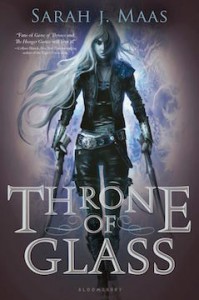
Throne of Glass
***Note: this review assumes that you've read the book.***
One-sentence summary: readers are promised an assassin and world-building, but get a dull-witted heroine, romance without geopolitics, and clunky writing.
What happened. Hmm, not much. It is just me, or is the lack of any sort of economic, social, and political details in young-adult fantasy worlds frustratingly unrealistic--especially when the governmental structure is a monarchy and the royals are characters that we're following? This book is about a competition to choose the King's Champion, in a world where many countries are subjugated by a tyrant king. Do we see the tyrant king ruling? No. He disappears for most of the book (no one knows where), only to return with his entire traveling party dead (no one, not even the Captain of the King's Guard, investigates why). Do we see control of trade, collection of taxes, information about armies and borders, or hear facts about previous wars? No. Do we see the king's son, the crown prince, do anything but play pool, check on the puppies that his favorite bitch has whelped, and make out with the assassin, Celaena? Well, I guess we hear that he's going to "council meetings" and that Duke Perrington is pressuring him to use Nehemia, the princess of Eyllwe, as a hostage to gain control of the famed "rebellion"--a rebellion we never see actual evidence of. The secondhand, afterthought accounts of these council meetings are absolutely the only political thing happening in this book.
But I digress. Here's a somewhat cynical synopsis:
Celaena Sardothien is the famed Assassin of Aderlan, who has been betrayed and thrown in a prison camp in Endovier, where she is being worked to death. The prince, Dorian, along with the captain of the King's Guard, Chaol, pluck her from Endovier with the promise that if she wins a competition to become the King's Champion and serves him faithfully for four years, she'll be freed. She agrees, and trains with twenty-three other potential champions, under the assumed name of Lady Lillian, all while she's closely guarded to make sure she doesn't kill anyone or escape the glass castle. There is a series of tests, which she passes, but one by one the champions begin to be brutally killed by some sort of beast, with their organs and brains devoured. Meanwhile, Dorian's mom wants him to marry, but Dorian can't abide the fawning nobles the queen has written for him on a list of appropriate women. No, Dorian has a crush on the assassin, and he visits her in her chambers at all hours. (Where is Philippa, her ladies' maid? Why, in all these medieval-style worlds, isn't there the usual custom that unmarried women have chaperones?) Chaol starts to get sweet on Celaena, too, but he won't admit it to himself because he's so strong and honorable. Like Dorian, Chaol also visits Celaena alone a lot. And for some reason it's his job to wake Celaena up in the morning for training and tests. (Seriously WHERE IS PHILIPPA?) Celaena is part fey, and readers quickly figure out that she's related to Elena, the first queen of Aderlan (get it? Celaena/Elena?), but somehow Celaena doesn't figure that out. In fact, Celaena doesn't figure out a lot of obvious things, which sort of belies the claim that she's a brilliant assassin. ("Look at how unnaturally strong and big Cain is getting! Oh! This document about wyrdmarks says the beast takes the flesh of the victim, and gives its strength to the summoner in return! It must be Nehemia summoning the beast!") So what does Celaena do? She talks a lot about clothes, whines about not being invited to balls, and stuffs her face with candies that appear in a bag on her pillow (the razor-sharp assassin is apparently a heavy sleeper) even though 1. one of her champion tests was expressly about deadly poisons, 2. someone is killing champions, and 3. she has no idea who gave her the candy. *headslap* She also excels at her tests, which are ordinary things like archery and scaling walls, and some tests that are just vague hand-waving on the author's part. (For instance we hear that one test was about "strategy," with no description of what that entailed.) Celaena discovers a passageway from her chamber that leads to the bowels of the castle, where she finds the tombs of Elena and Gavin, and speaks with Elena's ghost. Elena wants her to defeat the evil in the castle but for some reason can't say what the evil is. She gives Celaena an amulet, the Eye of Elena, to protect her. Eventually, Celaena and Cain are the last competitors--surprise, surprise--and Celaena defeats Cain, with a little help from Nehemia, who summons Elena to help counteract the magic that Cain is throwing at Celaena from the shadow world. After Celaena is declared the winner, Cain tries to stab her in the back, but Chaol intervenes and kills him first. For some reason, Chaol, the Captain of the Guard, has never killed a man, and is horrified at his action. Huh?
"Freedom." When Celaena was the Assassin of Aderlan, she had two rules: she refused to kill children or anyone from her home country. At the end of Throne of Glass, the king--a vile, violent, untrustworthy person--reluctantly makes Celaena his champion, not hiding his disdain of her, and tells her she must take every assignment he gives her, even if it's onerous, without argument, or he'll kill Chaol, Nehemia, and Nehemia's family. Given that this is the man who ordered the murder of five hundred "rebels," including women and children, it's clear Celaena is signing on to spend the next four years committing horrific acts at his whim. For some reason, Celaena still interprets this deal as "freedom." Go figure.
The competition. Since the whole point of the book is the competition, couldn't we have seen all of the tests? And couldn't some of them have been interesting? For a book that promised fantasy and action, this was all romance and Celaena's griping...until the last duel.
The romance. But at the same time, the romance was highly unsatisfying. Celaena is attracted to Dorian, and they have a couple of make-out sessions (one on her bed until 3 AM), but then they're oddly awkward around each other afterward, not clearly falling in love. (Dorian professes love, but backs off too willingly at the end, when Celaena says the king's Champion obviously can't date the crown prince.) Meanwhile, we're meant to think Chaol is more suited to her, but nothing happens between them aside from a big hug.
A premise too shaky to hold up the plot. I spent most of the first three quarters of the book wondering why Celaena was still hanging around the castle. We're told but not shown that she's a talented assassin. She's shackled at Endovier and on the journey to the castle because she's so good at escaping. From the very beginning, we hear that if she's even a few feet away from someone she could disarm him and slit his throat in a second--or use her chains to strangle him. So why didn't she escape the moment she was unshackled and in the castle? We're told she'd be "hunted" ceaselessly by the king, but isn't she good enough to elude the king's soldiers, with a whole world open to her? In fact, she waits so long to leave that she gives the king a weapon against her: her affection for Chaol and Nehemia. When she finds an actual secret passage out of the castle, she debates leaving and then concludes that she's better off staying and winning her "freedom." (See "freedom" discussion above.)
Celaena's character: The frivolous traits listed above--Celaena's love of fancy dresses, balls, chocolate, and puppies, along with her quirky temper while shooting pool--are supposed to make her endearing to us, supposed to set her apart from the usual, grave, Catniss-style kick-ass characters, and supposed to make us see that she hasn't lost her soul at Endovier. ("A shriek of rage ripped from her throat, and Celaena ran over to the pocket. She first screamed at the ball, then took the cue in her hands and bit down upon the shaft, still screaming through her clamped teeth. Finally the assassin stopped and slapped the three ball into the pocket.") Judging by the response on Goodreads, this writing strategy seems to have worked for most readers. But for me, these traits were just too incongruous, sometimes buffoonish. The Celaena we meet at the beginning of the novel is nearly broken by what she has seen. She's ruthless and supposedly skilled. She's outraged by the treatment of slaves in this political regime. She has killed people. She has seen enough to be an old soul, in an eighteen-year-old body.
Secondary characters. So many are two-dimensional. The king, Perrington, and Kaltain are less fleshed out even than Philippa, who rarely appears. Here's an example of Kaltain's lack of depth: "Perrington finished with a broad smile that made her instincts tell her to run, and run, and never look back. But all her mind could see was a crown and throne. And the prince who would sit by her side."--Chapter 40
 2
2
 1
1